YS STUDIO FIELD NOTES · THE OUTERWEAR KNOWLEDGE LIBRARY
Understand the build.
Design with intent.
See the layers, understand the choices and build a better brief. Illustrated explanations and source-linked guides for brands developing down jackets and padded outerwear.
THE VISUAL ATLAS / 01—36
Every construction
has a story to tell.
Start with eight essential explanations, then explore the complete atlas of down, padding, construction, testing and development.
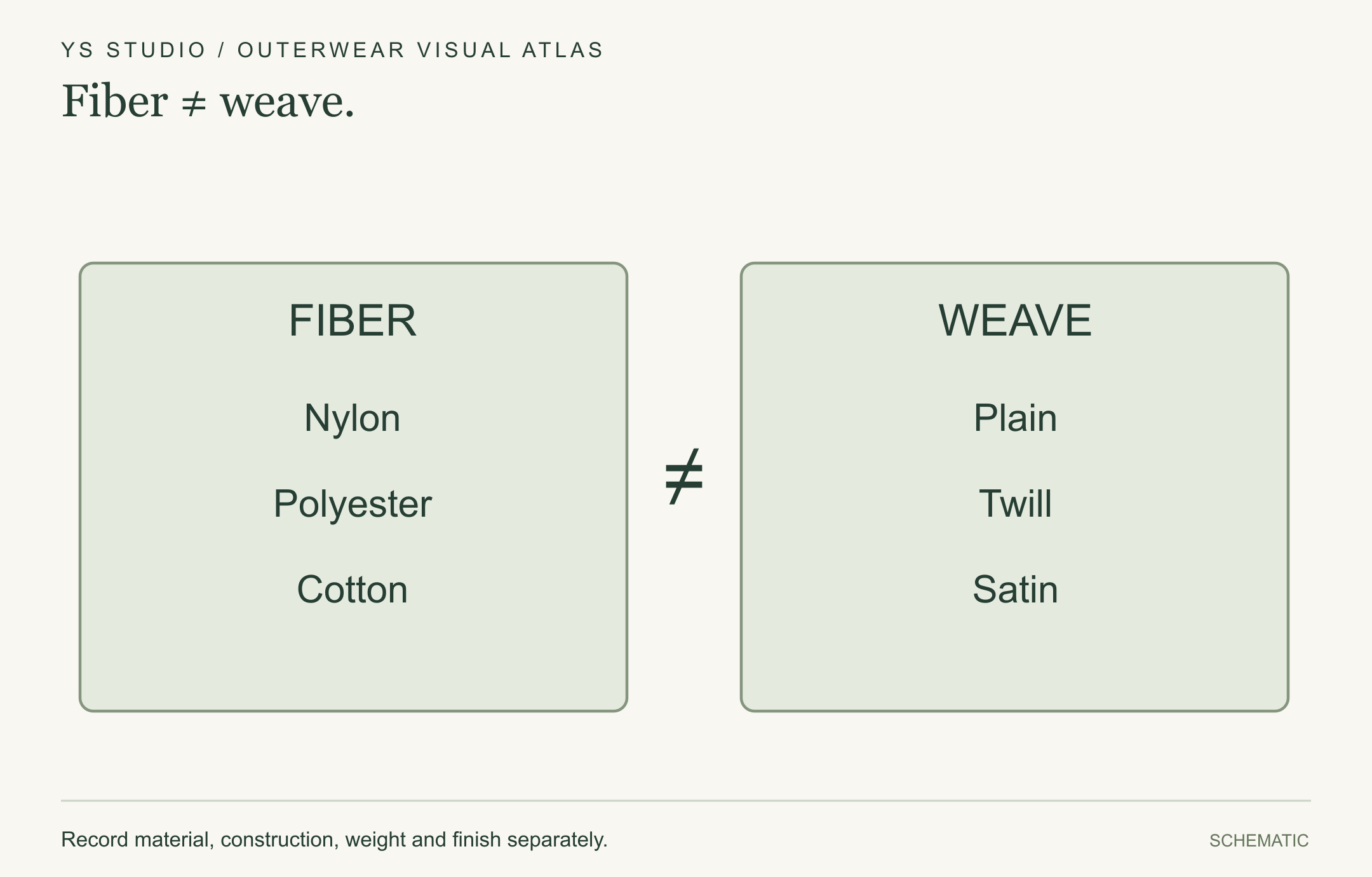
Fiber ≠ weave.
Fiber describes the material; weave describes how warp and weft interlace. Nylon, polyester and cotton belong in a different specification field from plain, twill and satin.
Record material, construction, weight and finish separately.
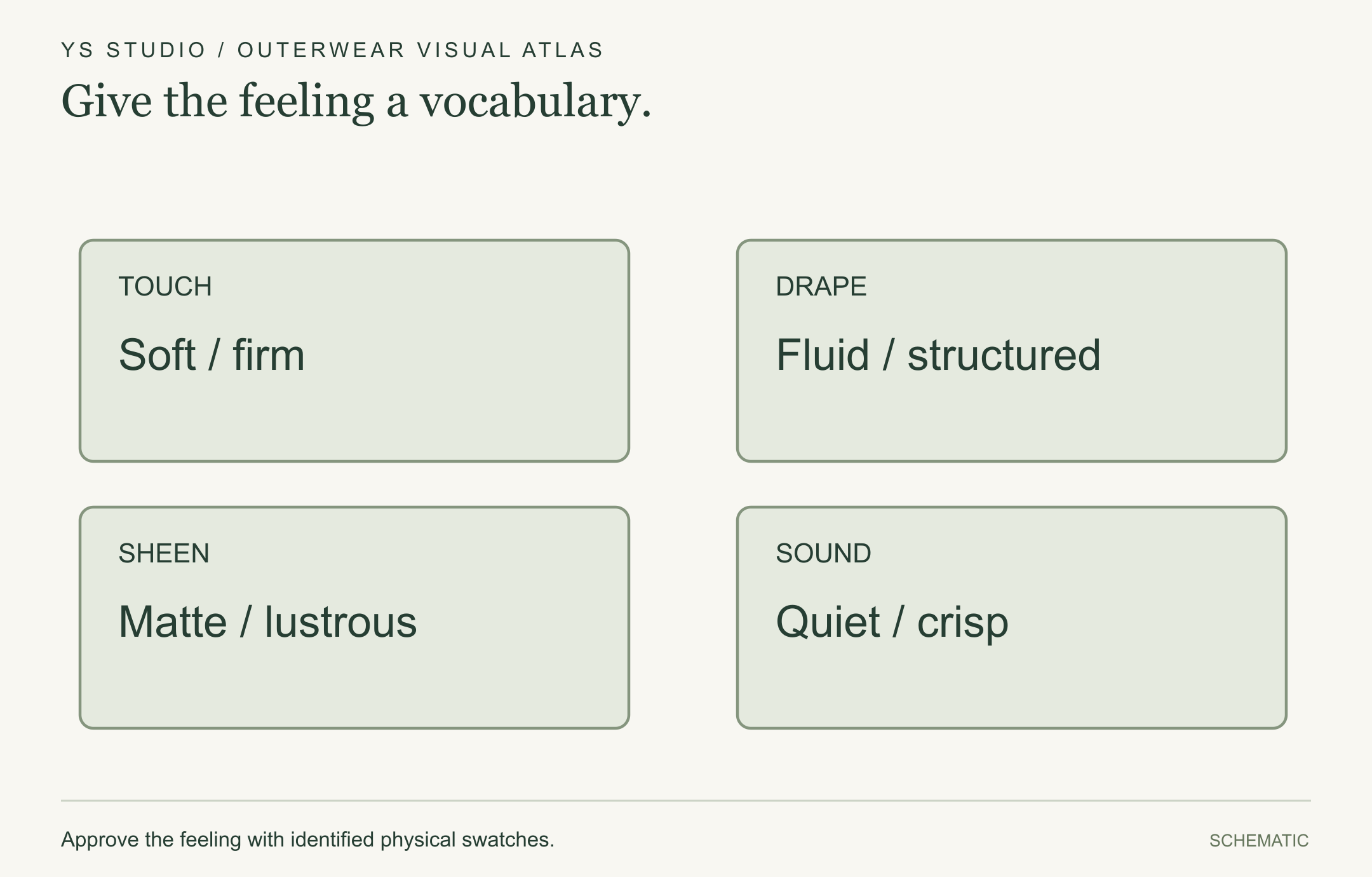
Give the feeling a vocabulary.
Touch, drape, sheen and sound are separate design choices. This vocabulary board is a set of descriptors, with no grade or test score implied.
Approve the feeling with identified physical swatches.
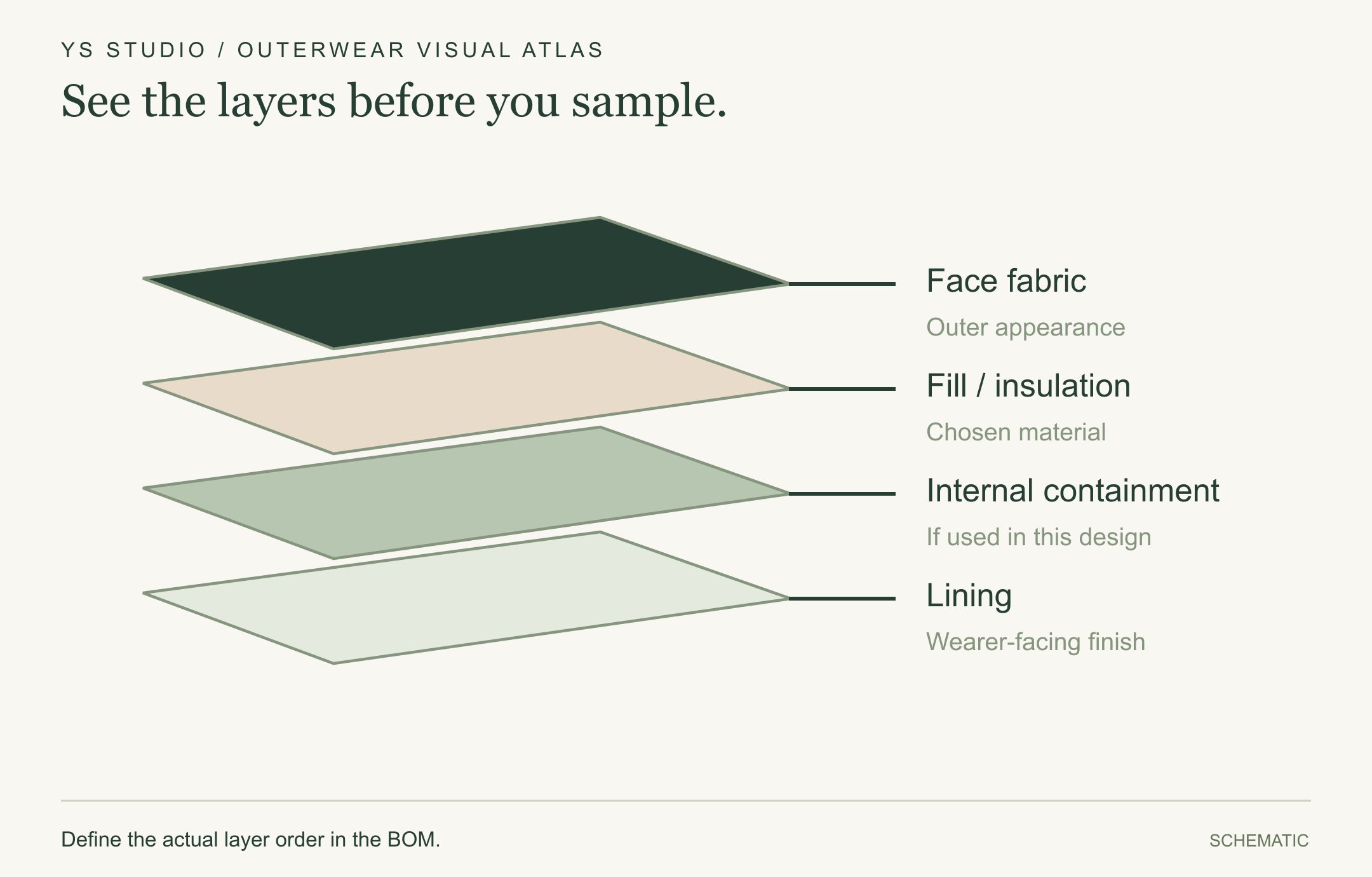
See the layers before you sample.
Identify the face fabric, fill containment and lining. A separate internal down bag is optional and depends on the chosen construction.
Define the actual layer order in the BOM.
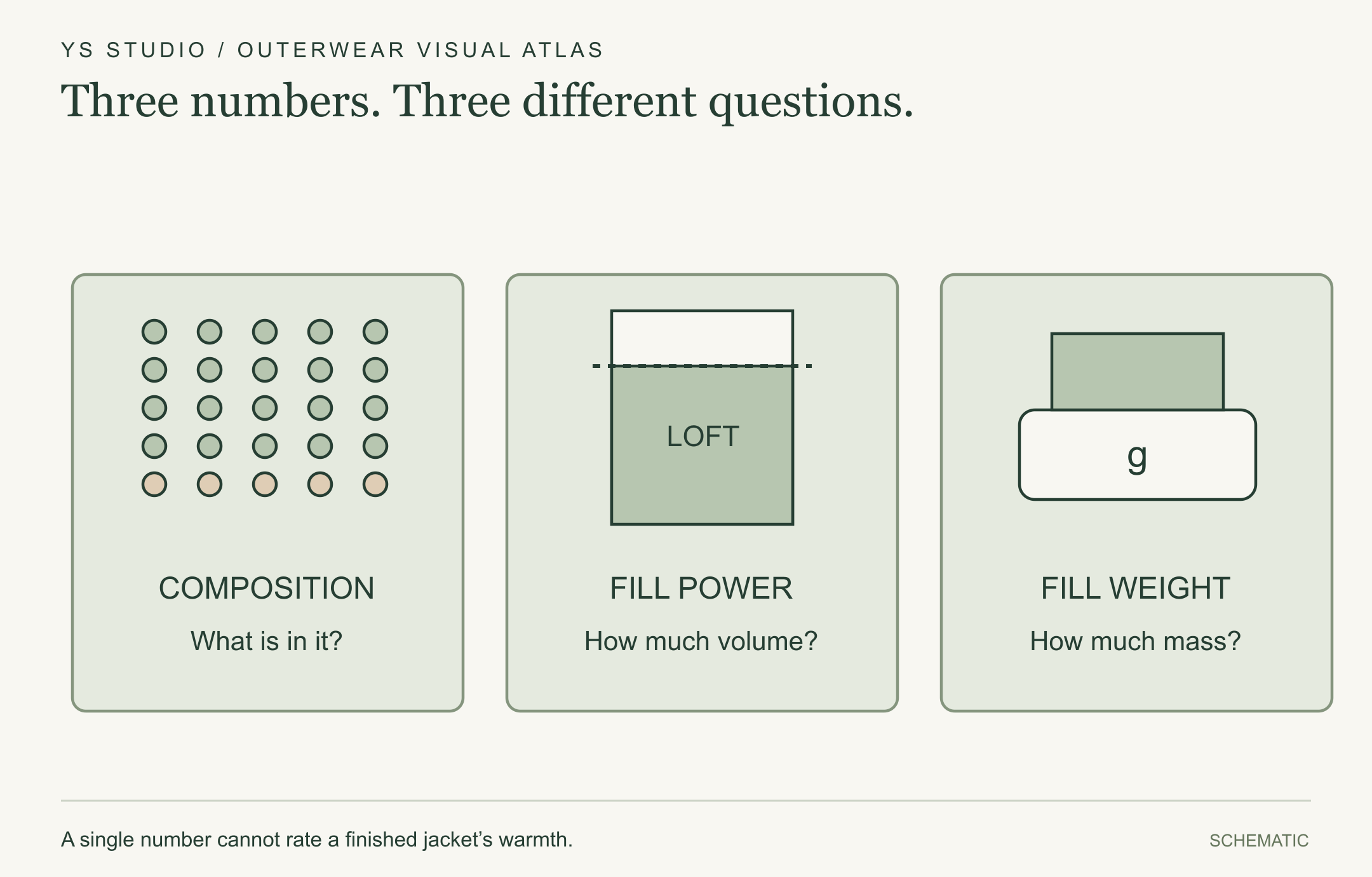
Three numbers. Three different questions.
Down percentage describes composition, fill power describes measured loft, and fill weight describes mass. Keep all three in the brief.
A single number cannot rate a finished jacket’s warmth.
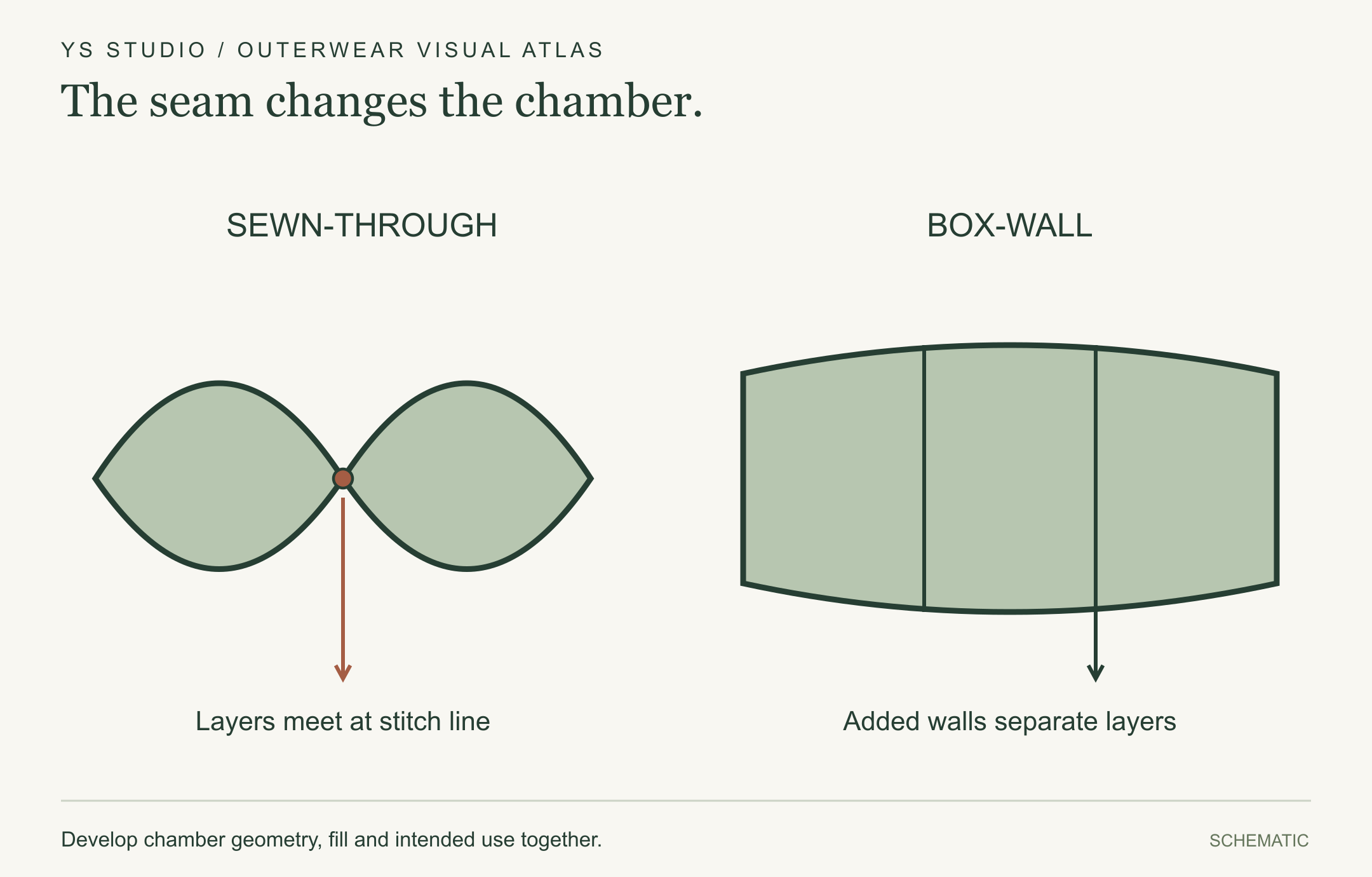
The seam changes the chamber.
Sewn-through seams join shell and lining; box-wall construction adds a separating wall. Cross-sections show the distinction.
Develop chamber geometry, fill and intended use together.
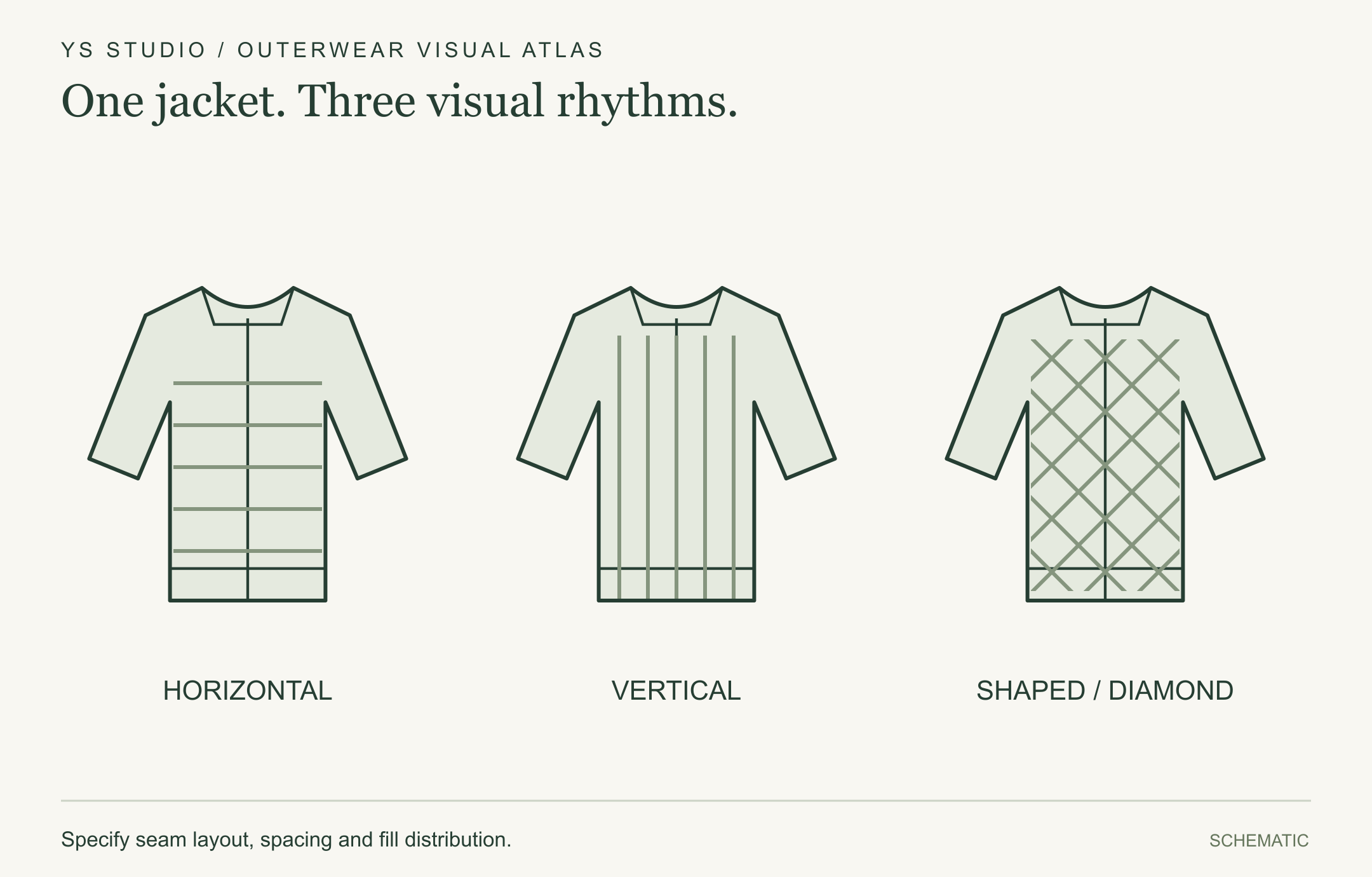
One jacket. Three visual rhythms.
Horizontal, vertical and diamond quilting change the visual language and the chamber geometry. None is a universal warmth grade.
Specify seam layout, spacing and fill distribution.
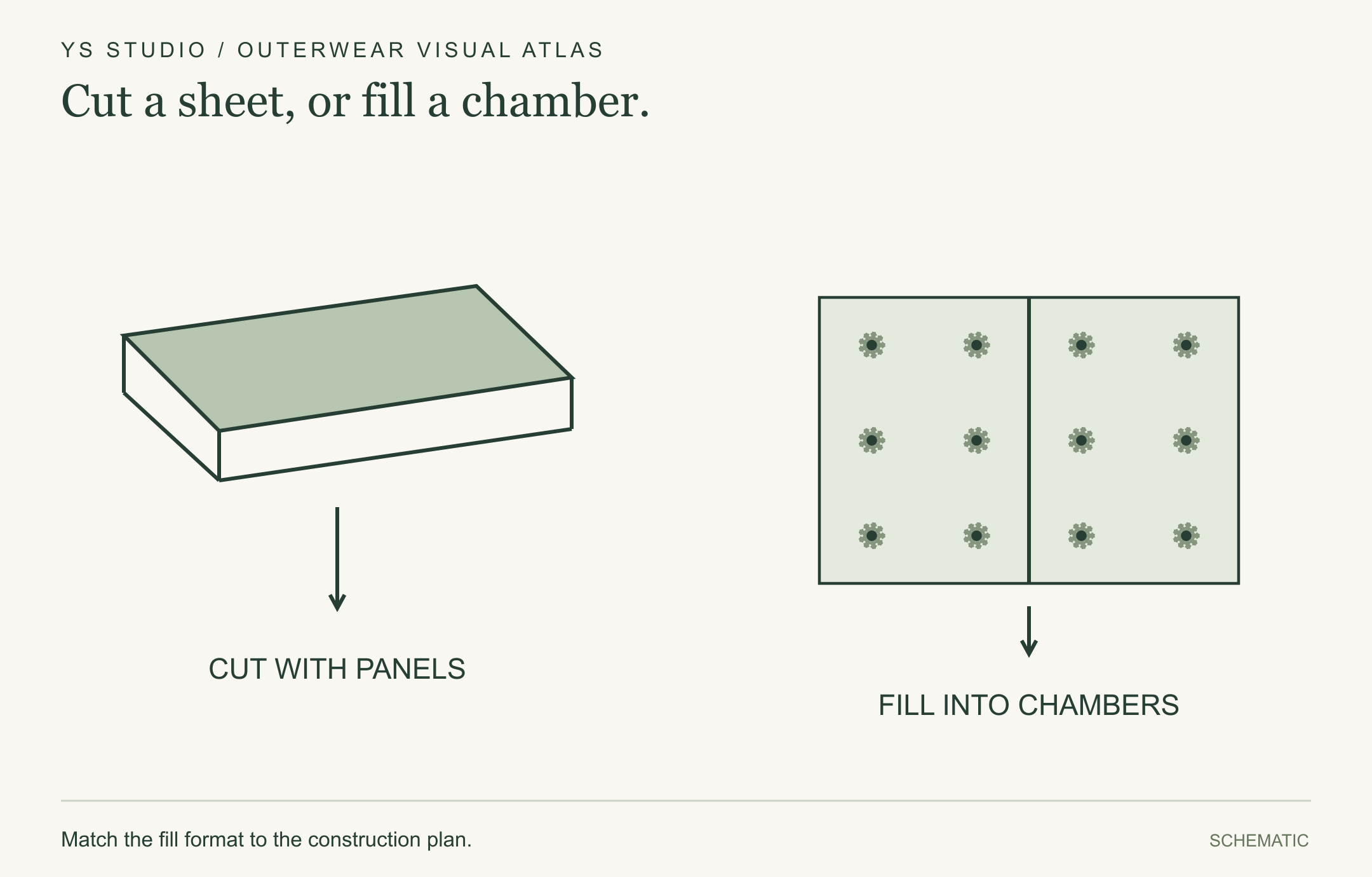
Cut a sheet, or fill a chamber.
Sheet batting is cut with panels; loose fill is placed into compartments. The format changes handling, containment and assembly.
Match the fill format to the construction plan.
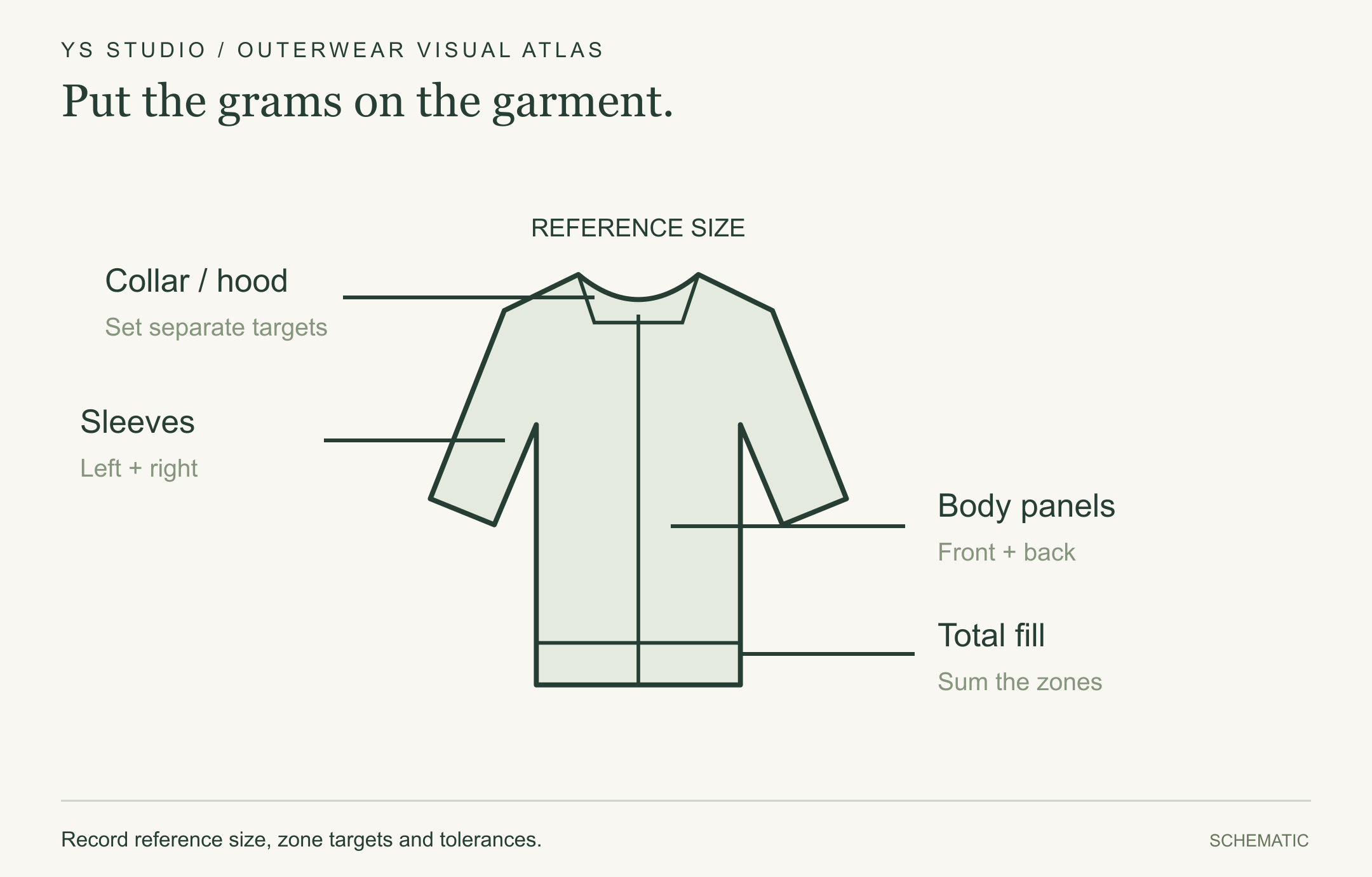
Put the grams on the garment.
A fill map assigns targets to the hood, collar, body and sleeves. It links an overall insulation concept to individual panels.
Record reference size, zone targets and tolerances.
THE KNOWLEDGE LIBRARY
Clear answers for better development.
Search by material, construction or decision. Each guide includes sources and practical questions to take into your project. Visit the Reading Room ↗
38 guides
How to start an outerwear project without a complete tech pack
A practical brief for turning references and ideas into a development conversation.
Read guide ↗Down vs. Feather: What Is the Difference?
A clear guide to the two components buyers often see combined in a down-jacket fill label.
Read guide ↗Down Percentage, Fill Power and Fill Weight Explained
Three different specifications answer three different questions. Keep them separate in a product brief.
Read guide ↗How to Compare Fill-Power Results Fairly
Why a fill-power number without its method and units can mislead a sourcing comparison.
Read guide ↗Why Down Fill Weight by Panel Matters
A panel-level fill map helps translate a warmth concept into a repeatable development instruction.
Read guide ↗Duck Down vs. Goose Down: What Buyers Should Compare
Species is one sourcing detail; it is not a shortcut for judging every quality or performance attribute.
Read guide ↗Sewn-Through vs. Box-Wall Baffles in Down Jackets
A visual construction choice that changes loft, seam placement, bulk and design character.
Read guide ↗Quilting Patterns and Channel Width: A Design Guide
Horizontal, vertical, offset and shaped quilting each communicate a different look and need a construction review.
Read guide ↗Face Fabric, Lining and Down Bag: The Three Layers to Specify
Clarify which layer is the visible shell, which touches the wearer, and which layer contains the fill.
Read guide ↗Downproofness vs. Air Permeability: Similar Questions, Different Tests
A breathable fabric measurement is not a direct substitute for assessing feather and down retention.
Read guide ↗Why Down Leaks from Jackets and How to Investigate It
A practical troubleshooting path for distinguishing fabric, stitch-line and assembly causes.
Read guide ↗Down Color, Shell Color and Product Appearance
Light or translucent shells can make fill color visible; agree appearance expectations early in development.
Read guide ↗Responsible Down Standard: What the Claim Does and Does Not Mean
Use standards precisely: a sourcing and animal-welfare standard does not replace a garment performance test.
Read guide ↗Down vs. Synthetic Insulation: Choose by Use Case
A comparison framework for product teams; performance varies by fill, construction and care system.
Read guide ↗What Does “Cotton-Padded Jacket” Actually Mean?
The market phrase can refer to different shell and filling materials. Name the fiber, layer and weight explicitly.
Read guide ↗Sheet Batting vs. Loose Fill in Padded Jackets
Two filling formats create different handling, sewing and appearance considerations during jacket development.
Read guide ↗How to Specify Synthetic Padding: GSM, Thickness and Recovery
GSM and thickness help define a padding brief, but they do not replace product-specific performance testing.
Read guide ↗Designing Insulation Zones for Comfort and Silhouette
Use panel maps to balance visual volume, movement and insulation intent across a jacket.
Read guide ↗Fit, Layering and Perceived Warmth in an Insulated Jacket
Warmth depends on the clothing system and fit as well as the insulation material.
Read guide ↗How to Write a Down-Jacket Tech Pack
A practical checklist for turning a visual direction into a sample-ready product brief.
Read guide ↗From Concept to Bulk: A Clear OEM/ODM Outerwear Workflow
A milestone-based route from design references through sample approval, production and shipment.
Read guide ↗Outerwear Sampling Stages: What to Review at Each Step
Name the purpose of each sample so teams can give actionable feedback and prevent approval gaps.
Read guide ↗Pre-Production Checklist for Down and Padded Jackets
A concise cross-functional checklist that connects approved design, materials, claims and production controls.
Read guide ↗How to Compare OEM and ODM Outerwear Partners
Evaluate development fit, communication and proof alongside price and minimums.
Read guide ↗How to Make Defensible Outerwear Performance Claims
Match each marketing sentence to a product-specific test, certificate or documented evidence.
Read guide ↗How YS Studio Builds Searchable Outerwear Knowledge
Our editorial approach to clear answers, primary sources, factory experience and responsible updates.
Read guide ↗Fiber vs. Weave: Two Different Parts of a Fabric Specification
Fiber names identify what a textile is made from; weave names identify how warp and weft yarns interlace.
Read guide ↗Plain, Twill and Satin: Reading a Woven Fabric Structure
Plain, twill and satin are the three basic weave families.
Read guide ↗Yarn Size vs. Fabric Weight: Why Denier Is Not GSM
Yarn linear density describes mass per length, while GSM describes fabric mass per area.
Read guide ↗How to Brief Shell Hand Feel, Drape, Sheen and Sound
Describe hand feel and appearance with separate, observable terms: soft or firm, fluid or structured, matte or lustrous, quiet or crisp.
Read guide ↗Water Repellency, Water Resistance and Waterproof Claims
Surface water repellency, resistance to water penetration and finished-garment protection answer different questions.
Read guide ↗Seam Type vs. Stitch Type in an Outerwear Tech Pack
Seam type describes how material components are arranged and joined; stitch type describes how sewing threads form the stitch.
Read guide ↗Needle, Thread and Stitch Density: Investigating Seam Pucker
Seam puckering can involve tension, fabric structure, feed or dimensional changes.
Read guide ↗Care Testing Before Bulk: Check the Complete Fabric Stack
Care validation should evaluate the assembled product under its intended cleaning procedure, including appearance, dimensions, fill distribution, trims and any performance claims that must survive care..
Read guide ↗What Drives the Cost of a Custom Down or Padded Jacket?
A useful cost discussion separates materials, insulation quantity, construction operations, trims, testing, packing, order allocation and logistics.
Read guide ↗Switching Outerwear Suppliers: What to Transfer and Reapprove
When changing suppliers, transfer the final specification, approved sample, BOM, measurement chart, material evidence, defect history and approval records.
Read guide ↗How to Learn Outerwear Materials: Books, Swatches and Tests
A useful learning route moves from fibers and yarns to fabric structures, finishes, insulation, construction, samples and verification.
Read guide ↗Your First Outerwear Line: Decisions to Resolve Before Sampling
For a first outerwear launch, define the customer, use, silhouette, shell hand, lining, fill, construction, target cost, quantity, market and launch plan.
Read guide ↗FROM RESEARCH TO YOUR NEXT SAMPLE
Have a reference, not a tech pack?
YS Studio works with brands on outerwear design and development through manufacturing and shipment. Bring your concept, target customer and quantity; the team can help define the next decisions.
Start an OEM/ODM conversation ↗Current starting MOQ: 300 units per style. Confirm project-specific materials, timing and color/size details with the team.