UNDERSTAND IT VISUALLY
Read a weave as an interlacing map.
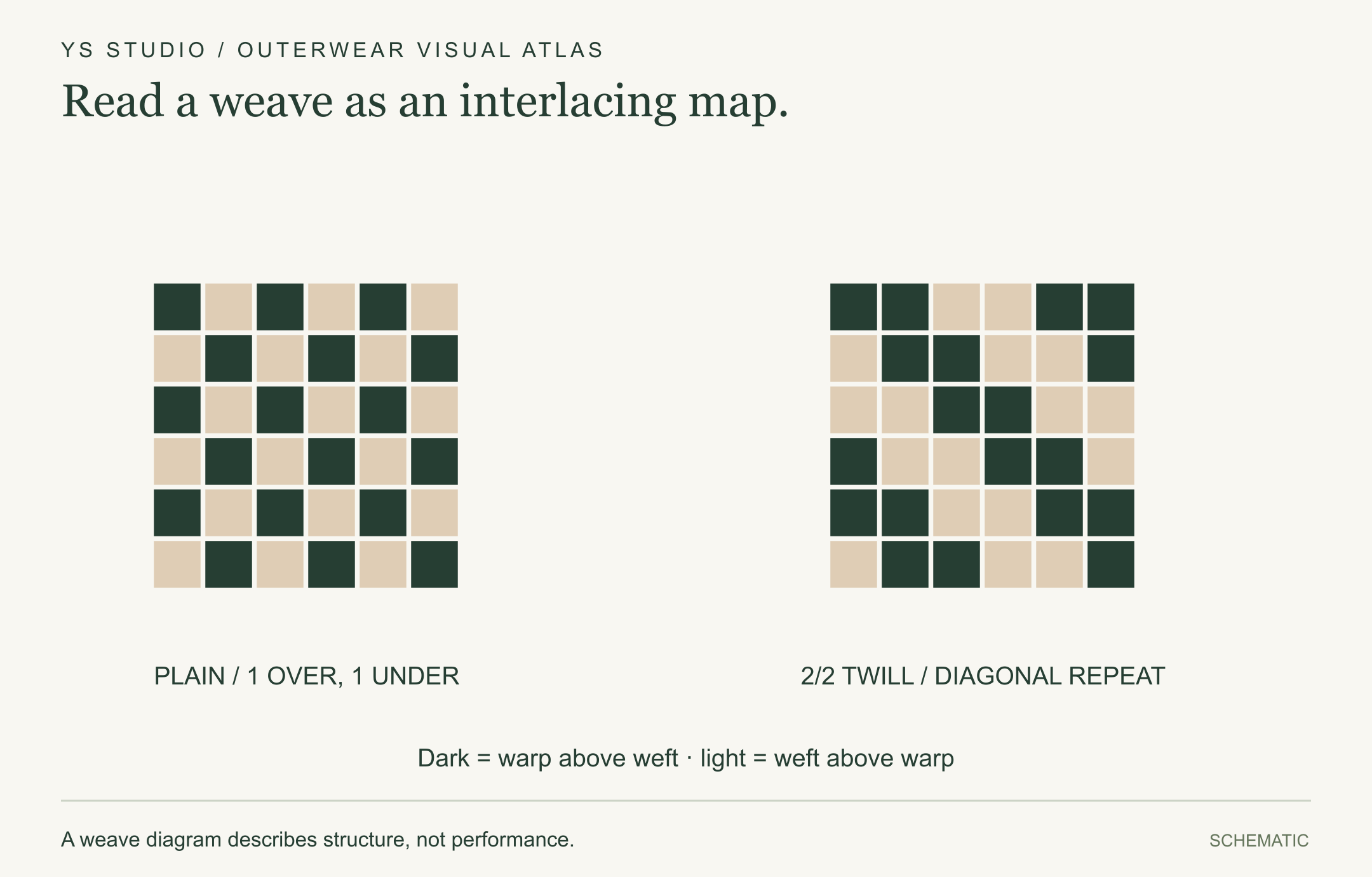
These simplified plan views show alternating crossings in plain weave and a diagonal repeat in a 2/2 twill. Colors identify yarn directions, not actual fabric colors.
A weave diagram describes structure, not performance.
Understand warp and weft
Warp and weft are the two yarn directions in a woven fabric. A weave diagram represents which set passes above the other at each crossing. It is a map of interlacing rather than a realistic picture of a finished shell.
Read the repeat
Plain weave alternates over and under at successive crossings. Twill structures create diagonal progression in their interlacing repeat. Satin structures distribute interlacings to create longer floats. Each family has variations; the actual yarns, density and finishing also matter.
Use a diagram as a shared language
When a supplier offers a “twill” shell, ask for the actual construction and an identifiable swatch. Record the face and back, direction and intended cut orientation. A photograph can help communicate surface character, but it cannot establish the complete construction.
Approve in the product
Develop the selected material into representative seams or a sample. Review hand, appearance, slippage, abrasion, leakage where relevant and the intended care process. Keep the test plan tied to the final chosen fabric rather than applying a general ranking to a weave family.
Questions buyers ask
Is every twill fabric heavier than plain weave?
No. Yarn size, density and finishing can change mass and hand within each family.
Does satin always mean silk?
No. Satin is a weave family; silk is a fiber.
Sources and further reading
External sources inform the technical explanations above. Standards and test requirements can vary by market; check current documents for your product.
This guide supports early product decisions. Confirm material data, applicable labeling rules and performance claims for the specific product and destination market.