UNDERSTAND IT VISUALLY
The seam changes the chamber.
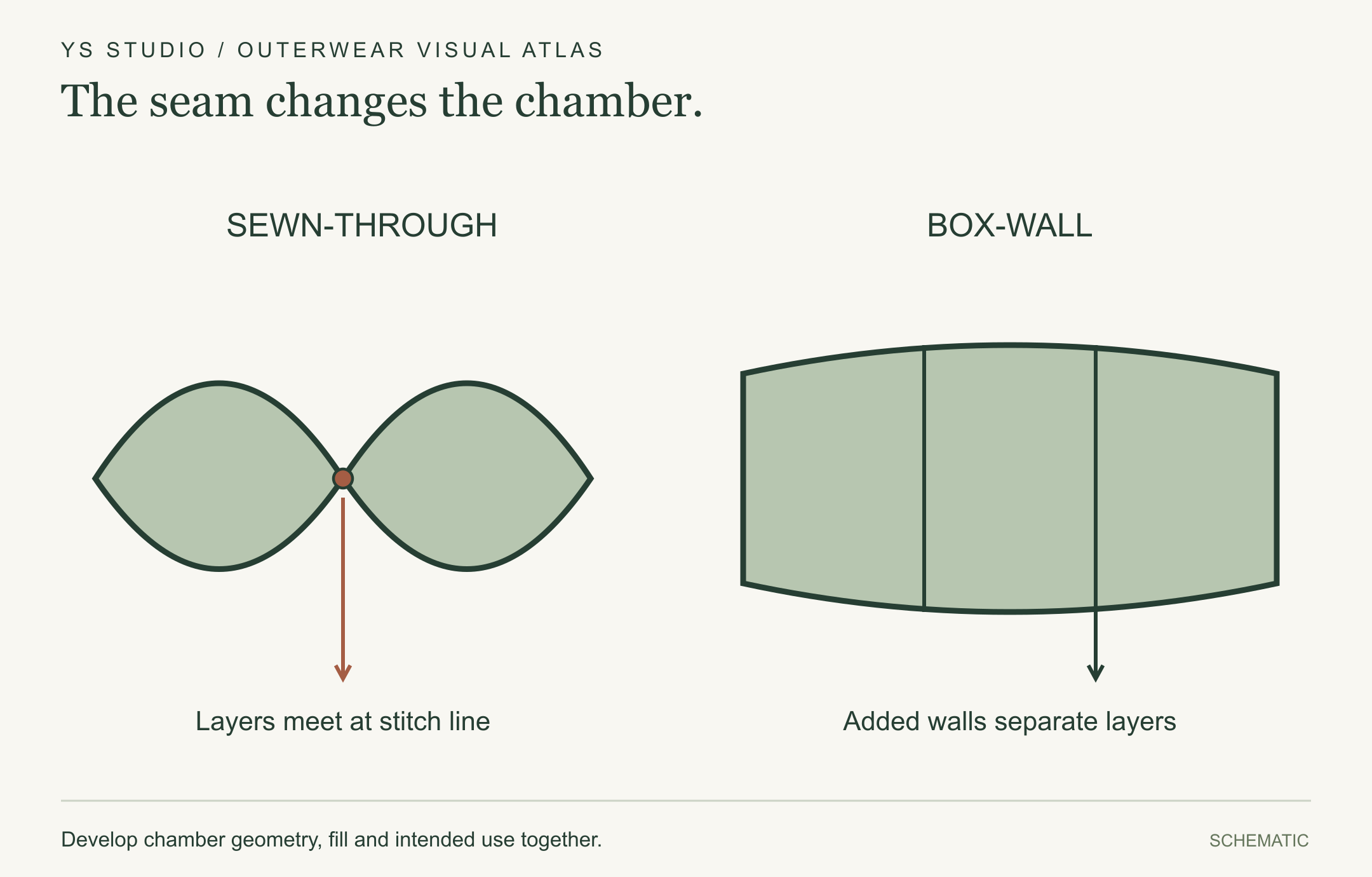
Sewn-through seams join shell and lining; box-wall construction adds a separating wall. Cross-sections show the distinction.
Develop chamber geometry, fill and intended use together.
Sewn-through construction
Shell and lining are stitched together, forming visible channels. It can create a clean, lighter, lower-bulk appearance and is common in many fashion and lighter-weight designs. The stitch line compresses insulation locally, so designers should consider channel width, spacing, fill distribution and intended conditions.
Box-wall construction
A fabric wall separates shell and lining to form a three-dimensional chamber. This can give insulation more room to loft across the panel, while adding materials, sewing operations, thickness and cost. Chamber dimensions and filling control need to be developed for the intended product.
The development decision
Use proportion, warmth intent, cost, aesthetic and target use to choose. Prototype the actual construction; a diagram cannot substitute for checking loft, mobility, leakage, bulk and appearance on a garment.
Questions buyers ask
Which construction is warmer?
There is no universal answer. Box-wall construction can preserve more chamber volume at seams, but warmth depends on dimensions, fill, pattern and use.
Are sewn-through jackets always cold?
No. They can be suitable for many designs; evaluate channel layout and intended insulation level.
Sources and further reading
External sources inform the technical explanations above. Standards and test requirements can vary by market; check current documents for your product.
This guide supports early product decisions. Confirm material data, applicable labeling rules and performance claims for the specific product and destination market.